
Shying Away
I want the praise but I don't know what to do with it

Some days back, when my widely published writer friend remarked, ‘I read your posts, you write well’, there was a surge of thoughts overlapping in my brain over the next few seconds.
Is she being nice to me? Of course, she wants to encourage me. Is she mistaking me for someone else?
It is taking a lot of conscious effort to keep track of my inner voice, and watch myself freeze for a second, and then fumble to find suitable words in response.
‘Praise and what it does to us’ was a prompt given by a fellow writer at the Ochre Sky Writing Circle. While contemplating my odd behaviour when confronted with a compliment, I began to dig and dig until I reached the place where I think it all began.
*
When I was still in Kindergarten, my older cousins took me to Chitrakala Parishath - a college of fine arts in our neighborhood - for a drawing and painting competition open to all children. I don’t have any recollection of that, but I ended up winning a Consolation Prize!
The following year, all of us cousins went back to the competition feeling we had a realistic chance at winning more prizes. I was competing in the 3-5 years age group while my cousins were in the senior categories as per their age. We were allowed to sit anywhere across the campus which had many trees and rock boulders. All of us settled down with our things under the shade of a tree and started to make our paintings.
Back at my aunt’s house where I was growing up, there was a landscape painting of the Sun setting over the river with a red hued sky in the background. That was the most beautiful painting I had seen and during my free time, I could be found attempting to make my own versions of it. Here too, I started out wanting to paint a whole landscape with additional elements in the foreground - like a whole bridge over that river. But somewhere in the middle of it, my cousins must have realized that my ambition had gotten the better of me. During the final hour of the competition, they secretively helped me here and there to finish the painting in time. Of course, we never told this to anyone at home.
Some weeks later, my aunt took us children for a walk up to Kumara Krupa Guest House and on the way back, we stopped by at Chitrakala Parishath to see if there was any announcement. There indeed was a list of winners pasted on the stone wall of the building. My aunt went from age group to age group looking for familiar names. And we found my name right at the bottom. I had once again won a Consolation Prize in my category. They asked us to attend the award ceremony on the following Sunday to collect the certificate.
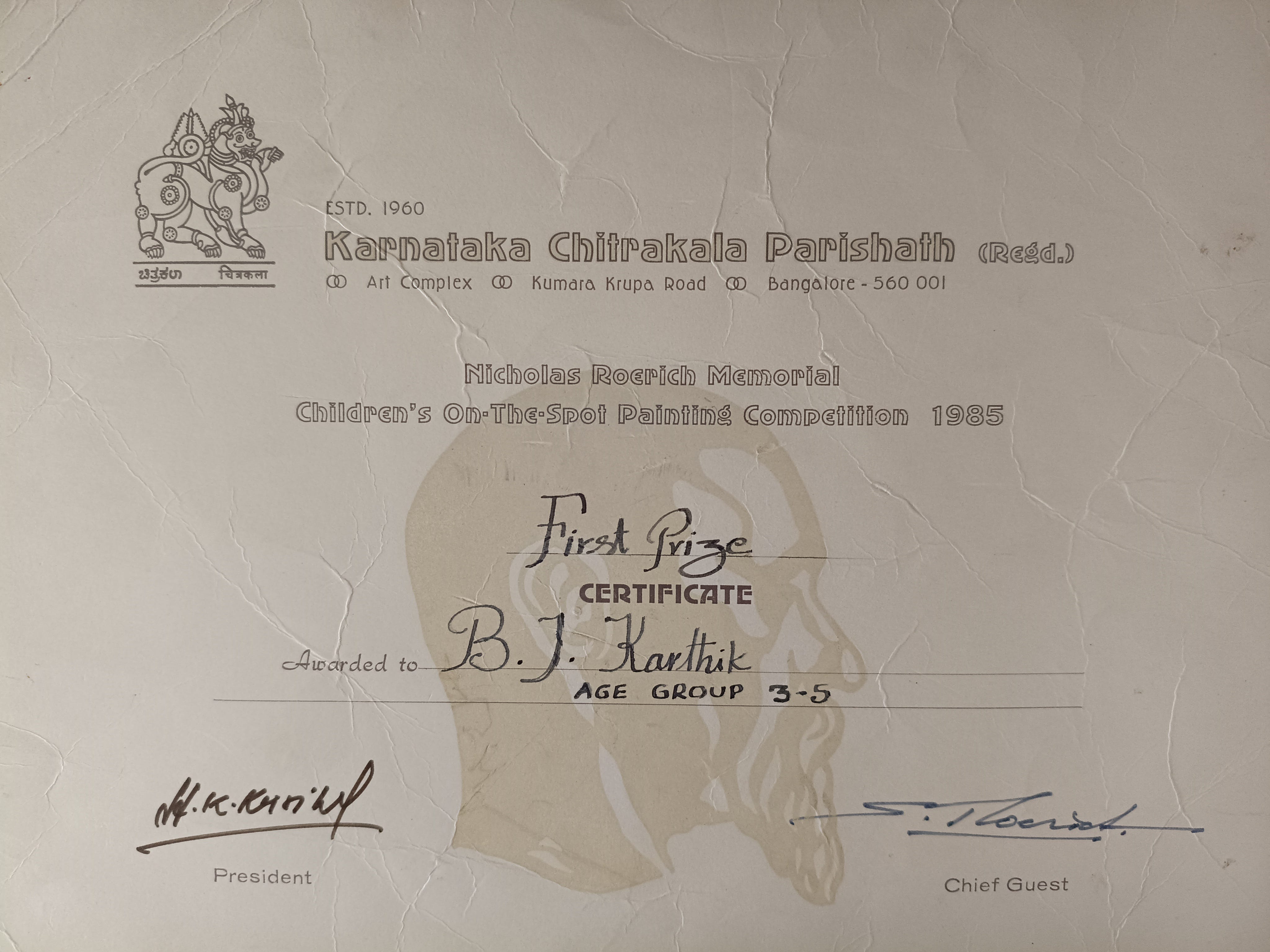
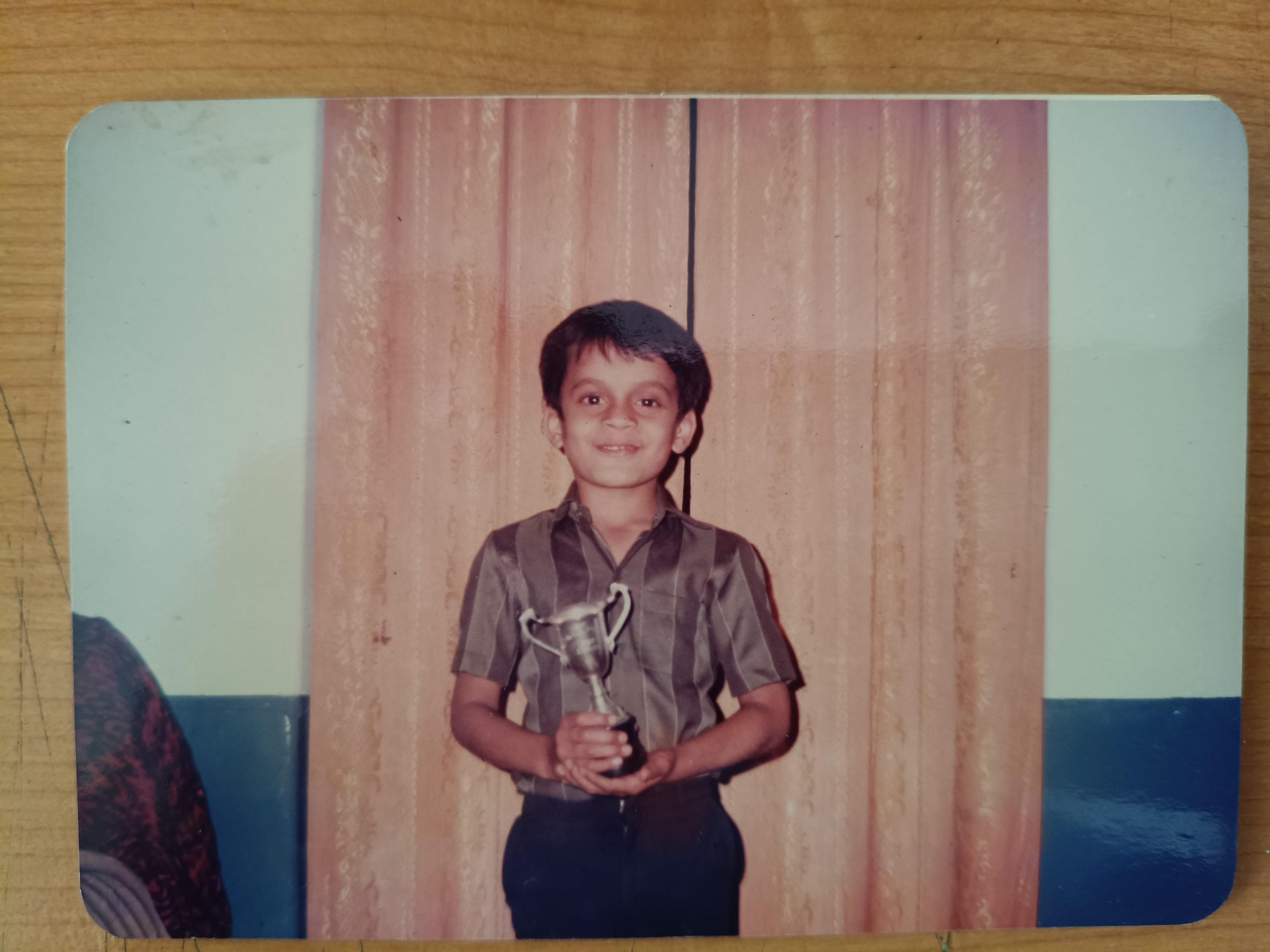
That Sunday morning, I was made to get ready and my elder cousin brother took me to Chitrakala Parishath at 9 am. I had never been to such a formal event before that and I remember being in awe of the proceedings. We sat in one of the back rows and waited. All of a sudden, they announced ‘BJ Karthik’ for the first prize. I was startled and wondered, ‘Oh wow! There’s another boy with the same name who has won the first prize?’. And they called out my name again and that’s when my cousin realized that it was indeed me they were calling for, and so he took me by the arm to the end of the row and asked me to go up on stage and collect the trophy. I was not at all sure about what was happening but I still walked all by myself between the rows of people clapping, went up on the dias and accepted the prize from an old man with a silver beard. I was just not ready to hold such a big trophy and the certificate in my little hands and really wanted to disappear from there.
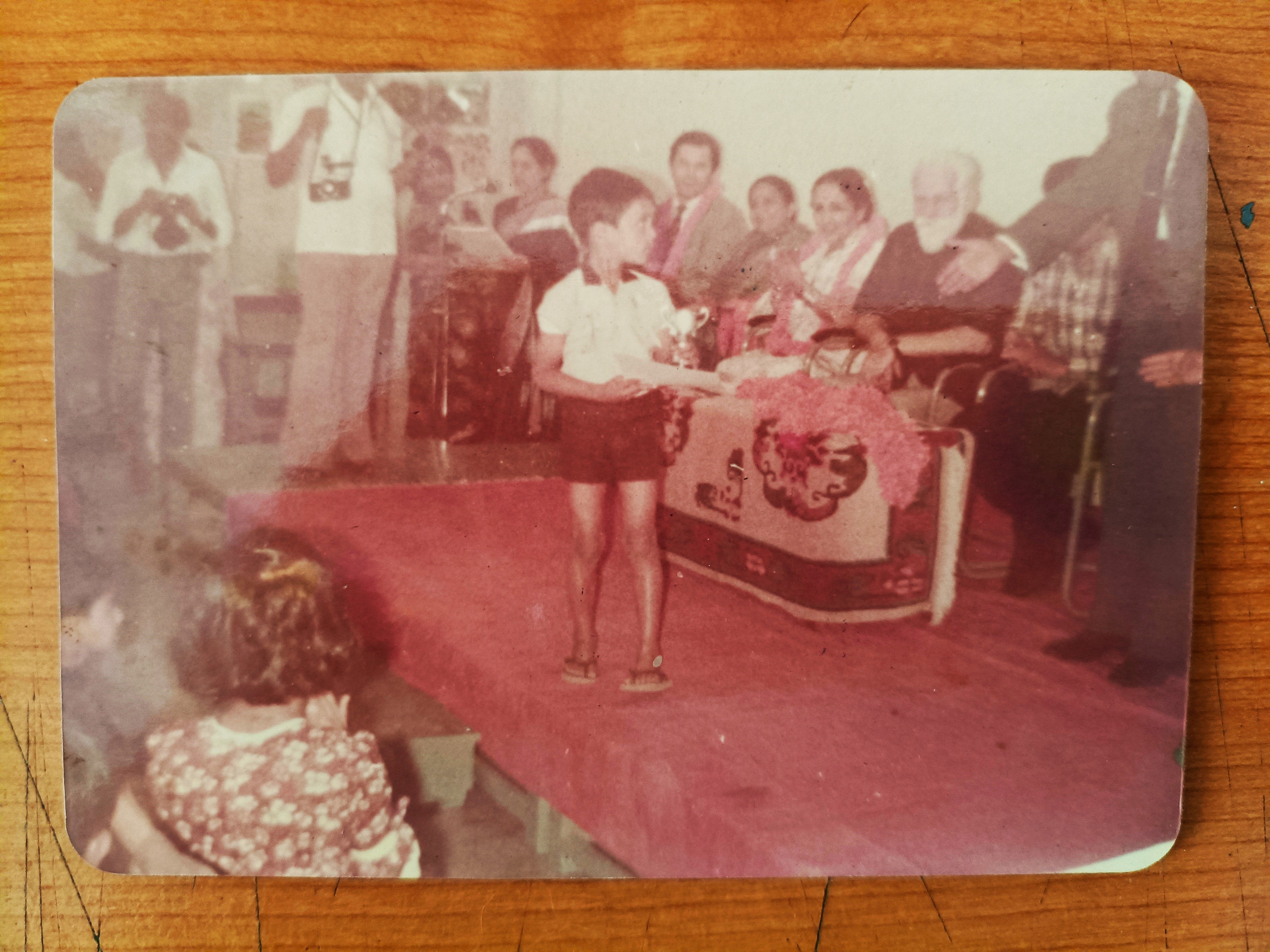
The Russian painter Svetoslav Roerich, who was married to Indian film legend Devika Rani (also in the picture) and based in Bangalore, was a huge patron of Chitrakala Parishath and this painting competition was being held in memory of his late father - Nicholas Roerich, also a renowned painter. The story goes that when Mr Roerich was shown the prize-winning paintings, he felt that my painting deserved to win the first prize and hence they had to make changes at the last moment to award me the joint first prize along with the other winner.
I have completely blanked out on what followed. Maybe we went home and there was a celebration but I don’t have a single recollection of anything after collecting the prize.
Dr Gabor Mate, renowned physician and bestselling author who has done extensive research on childhood trauma, points out that the word trauma comes from the Greek word meaning ‘wound’. Over the years, this word has become associated more with psychological wounds than with physiological wounds.
Within psychological wounds, the word trauma is usually applied for highly distressing childhood events like abuse, violence and poverty. Dr Mate categorizes them as Trauma - with a capital ‘T’. He adds that trauma is not what happened to us, but what happened within us because of what happened to us. So, he has put forward a second category of trauma - which he calls trauma with a small ‘t’. He says that this usually happens when a child’s emotional needs like being held at a time of distress, or being loved unconditionally are not fulfilled. And just like Trauma, these wounds also show up later in adult life.
Dr Mate shares that just like when we suffer a physical wound, a thin layer of skin grows over this childhood wound which makes that place more sensitive. And as a grown adult, an incident can trigger that wound which ends up making the grown person react in the exact same way they had reacted when the wound was first inflicted in childhood.
Returning to the story I shared at the start of this essay, when my writer friend complimented me saying, ‘You write well’, one of the thoughts that came rushing to me was, ‘Has she mistaken my Substack for someone else’s?’ - This is such a bizarre thought because my friend and I were sitting face-to-face and conversing in a private area with no one else around. She was not distracted by anything, and we were not at all making small talk. So, I don’t find any reason for her to mistake my writings for someone else’s. This is an example of what Dr Mate was saying about how in that instant, a grown adult ends up reacting like the 5 year-old child - the age when the wound was first inflicted.
Unexpectedly winning the first prize should have been a moment of great joy for me, but it turned out to be so nerve-wracking that I must have been completely exhausted by it. This is probably the reason why I don’t have any recollection of anything that happened when we returned home with that gorgeous shiny trophy. This event was not supposed to hurt me but it was my own reaction that caused the distress.
As Dr Mate says, ‘trauma is not what happened to you, but what happened inside of you because of what happened to you.’
What aggravated this wound further was the way the elders responded to my little wins during the school years. Even when I thought I was doing well in class, the usual response was, ‘So who are the kids ahead of you?’. I realize that many Indian parents hold back on appreciation because they don’t want their children to get complacent. Prizes won in extra-curriculars didn’t find much favour either, ‘All of this won’t get you far in life, you really need to focus on your studies’, they would say. One time I returned home very pleased with myself having won a prize at school, but I had to hold myself back from enjoying too much because someone else was unhappy at home.
Being a middling student in class, even the class teacher’s remarks in my report card usually said - ‘Can do better’ or ‘Satisfactory’. After more painfully long years in college, it was at work that I started getting appreciated for my efforts. I liked it for sure but I had not learnt how to react to the applause. Even when I knew how well my appraisal meeting would go, I would still be searching for words while accepting appreciation from my managers. I would often end up crediting the team and thanking the management for supporting me. One time, a manager got fed up and said, ‘Learn to accept compliments, Karthik.’ When I won the ‘Employee of the Year’ award, I was somehow convinced that it was a political move by the management to award me that year and I even said it out loud to my friends. It has taken me all these years to realize that by not valuing and celebrating that award, I had undone the years of toil that had taken me there.
‘I was at the right place at the right time’, ‘Lucky to have graduated and settled in the job before the 2008 crisis’, ‘It was a chance meeting that got me that interview’, ‘I learnt a lot because I was reporting to a taskmaster’ - the stories I have shared about my professional success has one missing part - me.
When I first started writing here on Substack, I would get overwhelmed with all the positive feedback in the comments section. It took a while for me to understand that I preferred that readers respond to my post by pressing the ‘like’ button over leaving a comment. The comments section made me jittery because of my confusion on how to react to the praise. I gradually realized that I yearn for compliments, but I just don’t know how to react to them in a healthy manner.
*
At this stage in life, I understand that our parents, guardians and teachers did the best they could with the awareness and resources they had. Dr Mate persuades us to avoid assigning blame or feeling sorry for ourselves, and instead approach our wounds with compassion and curiosity for the self. He says that our liberation from the past begins with firstly recognizing that our current behaviour patterns are tied to events way back in the past. Making this connection is key to realize that we are functioning in a default mode and we are not to blame for our current behaviour - because it is indeed connected to what happened in our childhoods. With the clarity of this awareness, we can then go on to seek help, disable the triggers, and learn ways to respond to life in a more wholesome manner.
Personal writing offers me a space to be my authentic self - display my vulnerability and accept myself as I am. Writing this essay was an opportunity for me to acknowledge that I am on the path of a gentle self-discovery. By publishing this piece, I am opening myself up to responses which gives me a chance to make connections and learn from them.
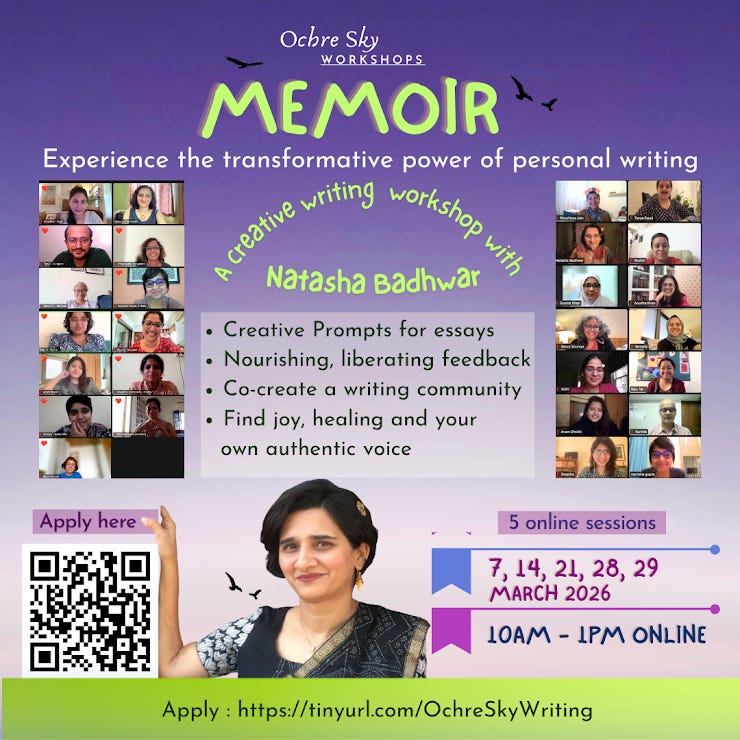
This journey in writing my story began with the Ochre Sky Stories memoir writing workshop mentored by Natasha Badhwar and Raju Tai.
If you wish to experience the transformative power of personal writing, do consider signing up for next next cohort here.
Watch/listen to Dr Gabor Mate in conversation with Mel Robbins on YouTube or Spotify.
My unusual childhood is a recurring theme in my writings. If you enjoyed this essay, here are some older posts you could read:
You are on a journey of discovering yourself and are doing it bravely.
Lovely Karthik! I was faced with a very strange situation very recently wrt to praise. Why do I respond like a child to it ? I don't know really and I think this overwhelm explains it partly....as usual love how you start at one place and with your curiosity reach so many different places ...!